
BMW
Used BMW for Sale in Phoenix
Arizona Elite Motors has been buying, selling, and driving BMW M cars long enough to know which ones are special and which ones come with surprises. The M division builds some of the most driver-focused performance cars in the world, and the Phoenix market sees a healthy supply of everything from iconic E46 M3s to current-generation G80s. Our team knows these platforms inside and out - the ones that reward a knowledgeable buyer and the ones that punish an uninspected purchase. Whether you're hunting for a screaming naturally aspirated straight-six or a twin-turbo monster that'll push 700 horsepower on a tune, we can find the right M car for you, stock or modified.

Related Categories
Model Guides
BMW Buying Guide by Generation
Our team has driven, sold, and modified these cars extensively. Here is what we know about each generation - the character, what to look for when buying used, and how each platform responds to modifications.
BMW BMW M3
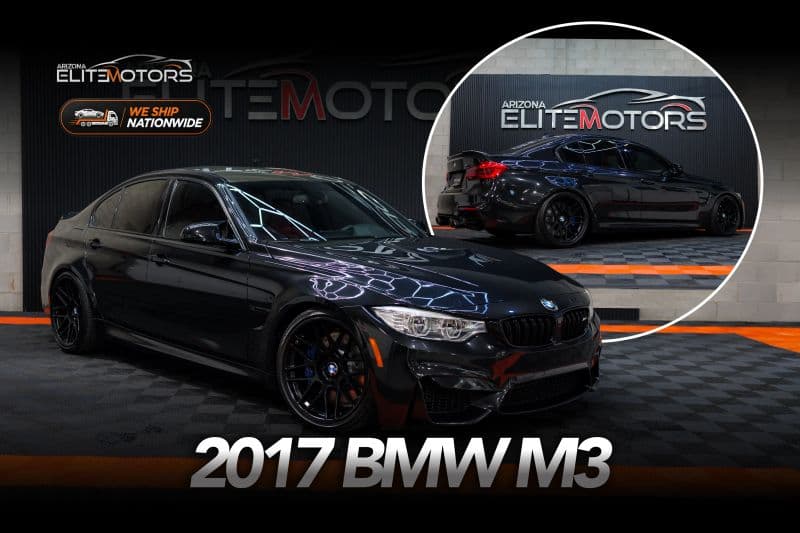
Browse BMW M3inventory →The M3 is the benchmark sports sedan - the car every other manufacturer measures itself against. BMW has built four distinct generations of M3, each with its own character, each with its own loyal following, and each with specific things to know before you buy. From the naturally aspirated scream of the E46 S54 to the twin-turbo brutality of the G80 S58, the M3 line represents BMW at its most focused and driver-centric. Arizona Elite Motors regularly carries M3s across generations, and our team has driven all of them enough to give you an honest read on each platform.
E46 M3
2001-2006- Engine
- BMW S54 3.2L Inline-6 (Naturally Aspirated)
- Horsepower
- 333 hp
- Pre-Owned Price
- $25,000 - $65,000
Character
The E46 M3 is the car most enthusiasts think of when they picture a perfect sports sedan - a naturally aspirated 3.2L S54 that pulls hard all the way to 8,000 RPM with a mechanical intensity that modern turbocharged cars simply cannot replicate. The steering is hydraulic, perfectly weighted, and communicates everything the front tires are doing. In manual form it's a complete driving experience, while the SMG sequential transmission remains a controversial choice that's loved by track drivers and hated by anyone who expected automatic behavior. The chassis balance at the limit is still class-leading 20 years later, and the E46's proportions have aged beautifully - this car turns heads the same way it did when new.
What to Look For
Subframe cracking is the defining issue on the E46 M3 and it must be inspected before any purchase - the rear subframe mounting points can crack under hard use, and repair costs range from moderate to significant depending on severity. Rod bearing wear is the second major concern, an issue shared across the S54 family that warrants bearing inspection on any high-mileage example. Cars equipped with the SMG transmission need their hydraulic pump and accumulator examined carefully, as replacement costs are substantial and functioning units are increasingly hard to source. VANOS (variable valve timing) solenoids and seals are a routine maintenance item on the S54 - a clatter on cold start is the giveaway. Look for documented subframe inspections, bearing clearance checks, and full service history above all else.
Modification Notes
The E46 M3 has a mature, well-understood modification scene built around extracting more from the S54 without changing its fundamental character. Exhaust upgrades - headers, catback, or both - free up throttle response and bring out the inline-six's natural voice at a modest cost. Individual throttle body intake systems improve airflow and make the car sound even more purposeful. Conservative ECU tunes specifically developed for the S54 can add 20-30 hp while maintaining reliability, though the naturally aspirated engine rewards mechanical prep - fresh bearings, VANOS service, and a full inspection - over aggressive power chasing. A properly maintained E46 M3 with tasteful mods at Arizona Elite Motors is a driving experience that would cost three times as much in a modern car.
E90/E92 M3
2008-2013- Engine
- BMW S65 4.0L V8 (Naturally Aspirated)
- Horsepower
- 414 hp
- Pre-Owned Price
- $25,000 - $55,000
Character
The E90/E92 M3 is the only V8 M3 BMW ever built, and that fact alone makes it special - the S65 4.0L revs to 8,400 RPM with a flat-plane crank character that sounds closer to a Ferrari than a BMW. This is an emotionally intense car that rewards drivers who understand how to use a high-revving NA engine - it wants to be driven hard, kept in the power band, and worked through corners rather than dragged out of them with torque. The sedan (E90) and coupe (E92) share the same powertrain, with subtle handling differences that most buyers find negligible. The manual gearbox is genuinely excellent, and the dual-clutch DCT option transforms the car into a track weapon. Every M3 with a V8 is a limited-production curiosity that BMW never repeated, which drives values upward among collectors.
What to Look For
Rod bearing failure is the critical issue on the S65 - this is not hypothetical, it has destroyed enough engines that any serious buyer must verify bearing service or budget for prophylactic replacement, which typically runs $1,500-$3,000 at a qualified shop. Throttle actuators (eight of them, one per cylinder) are a known wear item that can cause rough idle and hesitation - used units can buy time but proper serviced units are the correct fix. The subframe mounting points on E92s can crack under hard track use, though less severely than the E46. SMG-equipped E90s share the hydraulic pump reliability concerns from the E46 generation. The DCT requires fluid changes at regular intervals - neglected DCT fluid causes shift quality degradation that owners sometimes mistake for transmission failure when it's actually a simple service item.
Modification Notes
The S65 V8 has a dedicated aftermarket built around making it even more rewarding to drive. Individual throttle body intakes, headers, and exhaust systems are the natural first moves - they sharpen response and produce a soundtrack that belongs on a racetrack. Cam shaft upgrades extend the powerband and push peak output higher, though this is genuine engine work that requires a skilled shop. For those wanting serious power, centrifugal supercharger kits for the S65 are well-developed and can push the car past 500 hp while retaining the NA character below the powerband. Arizona Elite Motors carries modified E9x M3s where the work has been done correctly - a headers-and-exhaust E92 is a different car from a stock example, and we're transparent about what's been done on every unit we sell.
F80 M3
2015-2018- Engine
- BMW S55 3.0L Twin-Turbo Inline-6
- Horsepower
- 425-444 hp (Competition Package)
- Pre-Owned Price
- $35,000 - $65,000
Character
The F80 M3 marked BMW's return to a turbocharged inline-six in the M3 - a controversial decision among purists that proved itself in every objective performance metric. The S55 produces massive mid-range torque that the S54 and S65 never had, making the F80 dramatically faster in real-world driving conditions while retaining a manual transmission option that the M4 coupe shares. The Competition Package adds 19 hp, revised suspension tuning, and wider tires that sharpen the already capable chassis. As a daily driver it's genuinely livable - the adaptive suspension smooths out Phoenix roads while the DCT handles stop-and-go traffic without drama. Push it hard and it transforms into a sports sedan with supercar-relevant acceleration numbers, especially once tuned. The F80 is the M3 that finally made sense to buy over a 911.
What to Look For
The charge pipe connecting the S55's intercooler is a known weak point - the factory plastic pipe cracks under boost pressure and causes massive power loss without warning, a failure that is common enough to budget for an upgraded aluminum unit as immediate preventive maintenance. Oil pan gaskets and the front differential mounts are periodic maintenance items on higher-mileage examples. The water pump and thermostat follow BMW's pattern of plastic components that fail around 60,000-80,000 miles and should be serviced proactively. DCT-equipped cars need fluid changes - check service records. The F80 with Competition Package and documented maintenance history is the sweet spot of the generation, and examples with 60,000-100,000 miles are increasingly available at strong value.
Modification Notes
The S55 twin-turbo responds to tuning better than almost any engine BMW has ever produced - a stage 1 ECU tune from a reputable shop adds 80-100 hp on pump gas alone, transforming an already fast car into something genuinely shocking. The charge pipe upgrade is essentially required maintenance that also happens to be a mild performance modification. Downpipe upgrades paired with a tune push the car past 550 hp on 93 octane, and methanol injection kits allow even more aggressive timing on the stock turbos. Full bolt-on builds - upgraded intercooler, charge pipes, intakes, downpipes, and tune - push 600+ hp on the stock S55 hardware. Arizona Elite Motors has carried tuned F80s with complete documentation and they represent extraordinary value per horsepower at their price point.
G80 M3
2021+- Engine
- BMW S58 3.0L Twin-Turbo Inline-6
- Horsepower
- 473 hp (standard) / 503 hp (Competition)
- Pre-Owned Price
- $65,000 - $95,000
Character
The G80 M3 is the most complete sports sedan BMW has ever built - the S58 engine makes more power than any previous M3, the chassis is wider and more planted than the F80, and the available M xDrive AWD system transforms wet-weather capability while retaining a RWD-only mode for those who want it. The manual transmission returned in a six-speed form that feels properly connected, while the eight-speed automatic in Competition xDrive spec is legitimately quick shifting. Long-wheelbase models (M3 Touring in Europe, standard sedan in North America) prove the M3 formula works at any size. The controversial front kidney grille is large in photos but reads differently in person, and it hasn't hurt resale values. G80 M3 owners genuinely use their cars - track days, canyons, and Phoenix highways - without the anxieties that come with older platforms.
What to Look For
The G80 is recent enough that major mechanical failure patterns are still emerging. Early production examples (2021-2022) should have received software updates for transmission calibration and cooling system management - verify these with a BMW dealer's service record pull. The S58 shares architecture with the S55 and the charge pipe concern carries over conceptually - upgraded units are available and worth fitting. Brake wear on Competition xDrive cars is higher than expected given the AWD system's weight. The biggest risk on a used G80 is purchase from someone who drove it hard without performing oil changes on appropriate intervals - the S58 loves clean oil and shows it in longevity.
Modification Notes
The S58 is the most tuner-friendly engine in M3 history - bolt-on stage 1 tunes are adding 100+ hp on pump gas from the factory 473/503 hp baselines, bringing both manual and automatic G80s to 600 hp territory without touching hardware. Stage 2 builds with upgraded charge pipes, downpipes, and intercooler push 650-700 hp on the stock turbos. The platform is new enough that big-turbo builds are still maturing, but early results suggest 800+ hp is achievable on upgraded hardware. Arizona Elite Motors occasionally sources lightly modified G80s where stage 1 tunes have been applied by reputable local shops - these represent the best performance-per-dollar ratio in the current M3 lineup.
BMW BMW M4
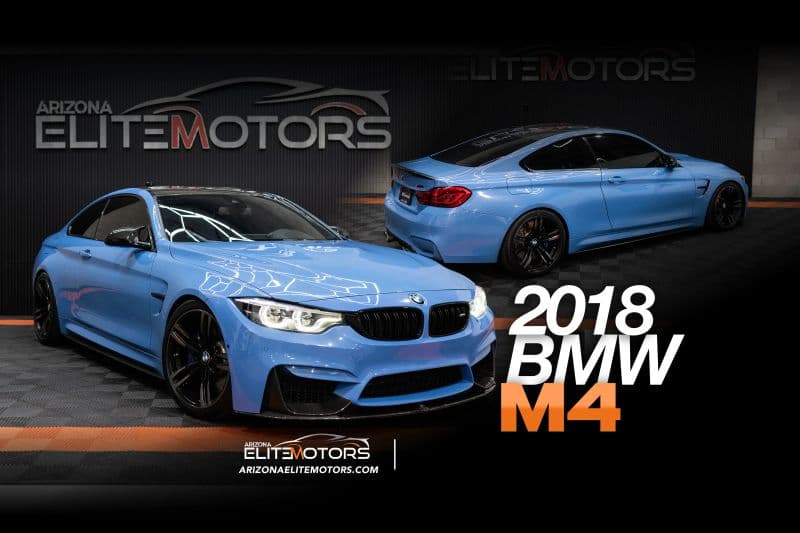
Browse BMW M4inventory →The M4 is the M3's coupe sibling - same powertrain, slightly different character. Where the M3 is the practical performance choice, the M4 leans into the sports car experience with its two-door body, lower roofline, and marginally sharper feel in back-to-back comparisons. Both F82 and G82 generations share their engines and most major components with their M3 counterparts, which means the modification and ownership knowledge transfers directly. Arizona Elite Motors carries M4s for buyers who want the performance of the M division in a coupe package, and the CS and Competition variants represent some of the most desirable driver's cars we stock.
F82 M4
2015-2020- Engine
- BMW S55 3.0L Twin-Turbo Inline-6
- Horsepower
- 425-454 hp (CS variant)
- Pre-Owned Price
- $35,000 - $75,000
Character
The F82 M4 shares the S55 engine with the F80 M3 but wears it differently - the coupe body is stiffer, the visual statement is more aggressive, and the reduced rear door use makes it feel more purposeful as a driver's car. The Competition Package brings 444 hp, upgraded suspension, and revised steering that sharpens the car's responses. The M4 CS (454 hp) is the high point of the F82 generation - lightweight components, more aggressive aerodynamics, and a suspension tune that rewards precision drivers. The F82 in DCT form is a legitimate track weapon that competes with far more expensive machinery. Manual-equipped F82s have held value well because the proper driving experience matters to M4 buyers.
What to Look For
Everything from the F80 M3 section applies directly to the F82 - charge pipe, oil pan gasket, water pump, and DCT fluid service. The CS model adds carbon fiber components that can be damaged by careless detailing or minor impacts - inspect the front lip, mirrors, and diffuser carefully on any CS example. Coilovers and brake upgrades are common on F82s that have seen track days - verify brake rotor thickness and inspect suspension components for wear if the car shows track history. Documented track use is not automatically a negative - many track-day M4s are better maintained than street-only examples because the owners paid close attention to consumables. The F82 represents strong value at current used prices.
Modification Notes
The F82 modification path is identical to the F80 - charge pipe upgrade as immediate maintenance, stage 1 tune for 80-100 hp gain, and a clear path to 600+ hp with downpipes and supporting hardware. The coupe body makes aero modifications more visually impactful, and the aftermarket offers everything from aggressive track splitters to subtle diffusers that maintain a clean look. Suspension tuning is well-developed for the F82, with coilover kits and sway bar packages that transform corner-exit behavior for track use while remaining streetable. Arizona Elite Motors has experience with modified F82s and can advise on which modifications add value versus which ones require careful evaluation.
G82 M4
2021+- Engine
- BMW S58 3.0L Twin-Turbo Inline-6
- Horsepower
- 473 hp (standard) / 503 hp (Competition) / 542 hp (CSL)
- Pre-Owned Price
- $70,000 - $130,000+
Character
The G82 M4 is the current-generation coupe, sharing the S58 powerplant with the G80 M3 and bringing BMW's widebody performance aesthetic to its most aggressive expression. The Competition xDrive variant adds AWD grip to a car that was already quick, and the M4 CSL (542 hp, limited production) is the collector's version - carbon fiber everywhere, rear seat deleted, and suspension tuning that rewards skilled drivers more than any street BMW in recent memory. The manual transmission returned for the base Competition model, which has driven strong demand among purists. The G82's visual presence is significant - wider fenders, large kidneys, and aggressive aero communicate exactly what the car is before it moves.
What to Look For
The G82 inherits the same early-build software update requirements as the G80 - verify dealer service records for transmission and cooling system calibration updates. Brake wear is elevated on Competition xDrive cars. The CSL commands significant premiums and deserves extra scrutiny - verify production sequence numbers, check for any accident history carefully given the carbon fiber construction, and confirm all CSL-specific components are present and undamaged. For Competition models, inspect the adaptive suspension components if the car has been lowered - lowering springs on adaptive-damper cars create geometry compromises that coilovers designed for the platform avoid.
Modification Notes
S58 tuning is identical in the G82 to the G80 - stage 1 tunes add 100+ hp on pump gas, stage 2 with hardware pushes 650-700 hp. The G82 coupe is particularly popular for aero development given its visual impact, and several shops have produced carbon front lips, dive planes, and diffuser kits that are both functional and aesthetic. The CSL's 4.0L flat-plane-crank engine in the M4 CSL deserves its own mention - it's a different, more focused experience than the S58, and the modification scene for it is still young but promising. Arizona Elite Motors can source G82 M4s in Competition, Competition xDrive, and CSL specifications depending on what a buyer is looking for.
BMW BMW M5
Browse BMW M5inventory →The M5 is BMW's statement that a full-size luxury sedan can also be a genuine supercar. Two generations define the modern M5 era at Arizona Elite Motors - the F10, which gave the M5 a twin-turbo V8 and remained rear-wheel drive only, and the F90, which added M xDrive AWD while increasing power to 600 hp standard. Both are extraordinary performance vehicles that also happen to be comfortable on a daily basis, which is why Phoenix buyers use them year-round. The M5's combination of passenger space, trunk room, and performance capability remains unmatched at any price point.
F10 M5
2012-2016- Engine
- BMW S63 4.4L Twin-Turbo V8
- Horsepower
- 560 hp (standard) / 600 hp (Competition)
- Pre-Owned Price
- $35,000 - $65,000
Character
The F10 M5 was a departure from its V10 predecessor - the S63 twin-turbo V8 traded the E60's operatic character for a broader, more accessible powerband that made the F10 faster in real-world driving while being easier to manage in daily use. Rear-wheel drive only, which remains its most significant appeal - the F10 requires driver engagement in a way that AWD M5s do not, and in Phoenix's dry climate it's exploitable in a way that rain-climate buyers might not experience. The Competition Package (30 hp boost, 600 hp total) and the later 30 Jahre M5 special edition (600 hp) represent the peak of the generation. F10 M5 values have stabilized at attractive levels given that the F90 has taken over as the current reference point.
What to Look For
Timing chain guide wear is the significant mechanical concern on the F10's S63 engine - guide inspection requires removing the front of the engine and is an expensive operation, but it's necessary on higher-mileage examples where it hasn't been documented. Oil cooler leaks are common and should be inspected by lifting the car and checking the underside forward of the engine sump. The Drivelogic transmission requires fresh fluid on schedule - shift quality degradation from neglected fluid is common and easily corrected. Executive Drive active roll stabilization has hydraulic components that can develop leaks - inspect the lines running across the front subframe. A properly sorted F10 M5 with documented timing chain service is an extraordinary buy at current prices.
Modification Notes
The S63 is one of the most tuner-responsive V8s BMW has ever produced. A stage 1 ECU tune adds 100-120 hp on pump gas, bringing standard F10s to 660+ hp and Competition cars to 720+ hp territory. Stage 2 builds with upgraded charge pipes, intercoolers, and downpipes push the car past 750 hp with reasonable reliability on supporting modifications. Big-turbo builds capable of 800-900 hp exist for the S63 and are well-documented - the engine block and rotating assembly handle the power better than most competitors at this displacement. Arizona Elite Motors has seen properly built F10 M5s delivering 700+ hp numbers that make them genuinely comparable to exotic supercar performance at a fraction of the cost.
F90 M5
2018-2023- Engine
- BMW S63B44T4 4.4L Twin-Turbo V8
- Horsepower
- 600 hp (standard) / 617 hp (Competition, CS)
- Pre-Owned Price
- $60,000 - $120,000
Character
The F90 M5 is the most complete performance sedan BMW has ever built - 600 hp standard, M xDrive AWD with genuine RWD-only mode, and available in Competition and CS variants that push the performance envelope further. The updated S63B44T4 engine produces more power with better efficiency than the F10's S63, and the eight-speed torque converter automatic is the best gearbox in the segment. M xDrive's ability to meter power front-to-rear in real time makes the F90 grip-limited only in the most extreme conditions, while flipping into RWD mode reveals the rear-drive character that M5 purists demand. The M5 CS (2022-2023) is the definitive version - 627 hp, carbon ceramic brakes standard, carbon fiber exterior panels, and a weight reduction program that makes it feel fundamentally sharper than the Competition.
What to Look For
F90s are recent enough that catastrophic failures are rare, but deferred maintenance is the primary risk on used examples. The nine-speed transmission (nine-speed in Competition spec, eight-speed in standard) benefits from fluid changes at 40,000-mile intervals - verify this if buying from a non-BMW dealer source. The S63's oil cooler is a carry-forward concern from the F10 generation and should be visually inspected. Brake wear is substantial on Competition and CS cars, especially on examples that have seen track days - rotor and pad thickness should be checked. Carbon ceramic brake-equipped CS cars require specialized pad compounds and careful inspection of the ceramic rotors for cracking, which can happen from thermal shock events. The M5 Competition xDrive at current used prices is remarkable value.
Modification Notes
The F90 S63B44T4 responds even better to tuning than the F10's version - stage 1 tunes add 100+ hp on pump gas, moving standard cars to 700+ hp and Competition cars to 720+ hp territory without hardware changes. Downpipes and intake upgrades combined with a stage 2 tune push the F90 past 750 hp reliably. High-horsepower F90 builds with upgraded turbos are capable of 900+ hp, and the AWD system handles launch forces that would destroy a RWD-only car. Methanol injection is popular on F90s running high-power tunes as it provides knock resistance and charge cooling beyond what pump gas alone allows. Arizona Elite Motors evaluates modified F90s on a case-by-case basis and maintains relationships with Phoenix shops that do proper S63 work.
FAQ
Frequently Asked Questions
Which M3 generation should I buy?
It depends entirely on what you want from the car. The E46 is the purest driving experience - a naturally aspirated S54 screaming to 8,000 RPM with a short-throw manual, but it requires a pre-purchase inspection focused on subframe cracks and rod bearings. The E90/E92 V8 is the emotional choice - that S65 at 8,400 RPM is unlike anything else BMW has built before or since, but rod bearing maintenance is non-negotiable. The F80 is where the car became genuinely fast in a modern sense - a tuned S55 twin-turbo will walk most supercars - and it's the most practical for daily use. The G80 is simply the best M3 ever made by most objective measures, with 503 hp stock and room to grow. Arizona Elite Motors carries examples across all generations so you can compare them side by side.
M5 F10 vs F90 - which should I choose?
The F10 M5 was the last of the traditional approach - rear-wheel drive only with a 4.4L twin-turbo V8 making 560-600 hp, and a tuner's dream car that can hit 800 hp on the right build. The F90 brought M xDrive AWD (with a real RWD-only mode for those who want it), 600-617 hp stock, and the Competition and CS packages that push it further. The F90 is the faster, more capable car in almost every measurable way, and the RWD mode satisfies the purists. If you want simplicity, the F10 at a lower price point is still an extraordinary machine. If you want the most complete performance sedan on the road, the F90 is the answer.
Are modified BMW M cars a problem?
Not inherently, and at Arizona Elite Motors we actively carry modified M cars when the work is quality. A properly tuned F80 or F90 with known supporting mods - charge pipes, oil catch can, tune from a reputable shop - is often a better buy than a neglected stock example. What matters is documentation, the shop that did the work, and the car's service history. We review every modified M car in our inventory and can speak to the specific modifications on each one.
What should I know about BMW M maintenance costs in Phoenix?
Phoenix's heat is a factor - coolant systems work harder here, and oil temps run higher than in cooler climates. Plan for more frequent oil changes than the BMW on-board computer recommends, especially on boosted cars. The S54, S65, and S55 all benefit from more aggressive oil change intervals in Arizona conditions. Budget for high-quality fluids and a shop that specializes in M cars - the engineering is specific enough that generalist mechanics often miss issues that a BMW specialist catches immediately.
Does Arizona Elite Motors offer pre-purchase inspections on BMW M cars?
Every M car in our inventory goes through a thorough inspection before we price and list it. We know the platform-specific failure points - subframe cracks on E46s, rod bearings on E9x V8s, charge pipes on F-chassis turbos - and we document what we find. If you're considering a private-party M car purchase, we're also happy to connect you with our trusted inspection partners in the Phoenix area.